How this calculator works
Use this free cone total surface area formula page to calculate results, review the formula, and check a worked example before using the answer.
Cone Total Surface Area Calculator is built for students, engineers, designers, and users applying practical geometry formulas. The goal is not only to return a number quickly, but also to show the formula clearly enough that you can explain the result, compare it with a manual check, and catch obvious input mistakes before the answer is reused somewhere else.
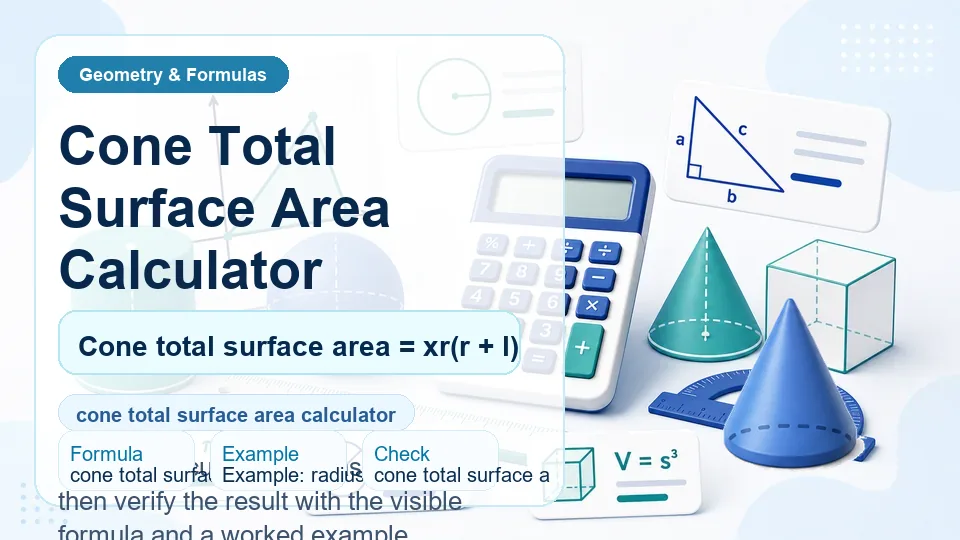
Example: radius 3 and slant height 7 gives surface area about 94.25.
- Enter the values for the formula
- Review the result and units
- Compare with the worked example
Long-tail questions this page helps answer
Many visitors do not search only for the exact calculator name. They also look for formulas, worked examples, step-by-step explanations, spreadsheet-style checks, and nearby comparison terms. This page is written to support those longer search intents without hiding the exact calculation behind vague copy.
In practice, that means you can use the calculator for the fast answer and still keep the surrounding context: the formula, common mistakes, and a simple path to a related guide if you need more explanation than the final number alone can provide.
When to use Cone Total Surface Area Calculator
Cone Total Surface Area Calculator is most useful when you need a quick result but still want to understand what the calculator is doing. It works well for everyday checks, homework-style verification, spreadsheet spot checks, and situations where you need to confirm whether an input or unit change has a meaningful effect on the final answer.
- Apply coordinate, area, volume, or force formulas with visible math and a quick verification path.
- Check whether measurements and units are consistent before using the output in homework or design work.
- Compare a manual geometry step with a calculator result when precision matters.
Step-by-step review before you trust the result
Even a simple calculator can produce the wrong answer if the wrong values are entered or if the formula does not match the real situation. The safest workflow is to check the intent first, then the inputs, then the formula, and only then the final output.
- Enter all coordinates or dimensions using one consistent unit system.
- Review the formula and make sure each variable matches the correct geometric meaning.
- Compare the final output with a rough physical estimate so obviously wrong answers stand out.
| Reference | Value | Why it matters |
|---|---|---|
| radius: 3 | slant Height: 7 | Total surface area: 94.2478 | Default example |
| radius: 4 | slant Height: 8.75 | Total surface area: 160.2212 | Alternate input |
| radius: 4.5 | slant Height: 10.5 | Total surface area: 212.0575 | Larger-value check |
How to verify the result without guessing
The calculator is the fast path, but the safest workflow is to keep one manual verification path in mind. That is especially useful if you are moving the answer into a spreadsheet, a quote, a lab note, a homework step, or any place where a copied input mistake can survive for too long.
- Start with the same inputs shown in the first reference row and verify that your manual result matches Total surface area: 94.2478.
- Review the visible formula — Cone total surface area = ?r(r + l) — before you change units, order, or rounding.
- If the answer seems off, compare the page with a related geometry & formulas tool before assuming the formula is wrong.
Common mistakes and final checks
Most calculation errors do not come from complex math. They come from swapped units, copied values, premature rounding, or using the wrong interpretation of the result. Reviewing a short checklist before you move on is often enough to catch the problem early.
Common mistakes
- mixing units or coordinate order
- using the wrong geometric measurement
- trusting a precise answer built from rough inputs
Before using the answer
- Keep all inputs in one unit system.
- Match each variable to the formula correctly.
- Compare with a rough estimate before trusting the final number.
Common questions
How does this cone total surface area formula work?
The Cone Total Surface Area Calculator uses this formula: Cone total surface area = ?r(r + l). Enter your values, then compare the result with the worked example on the page.
Can I use this cone total surface area formula for final decisions?
Use it for quick educational estimates. Verify units, rounding, and any official requirement before relying on the result.
What inputs should I double-check?
Check that every input uses the expected unit, especially length, time, percentage, angle, or volume fields.
What formula does Cone Total Surface Area Calculator use?
Cone Total Surface Area Calculator uses Cone total surface area = ?r(r + l). The page also shows a worked result so you can compare the formula with a live answer instead of trusting a black-box number.
Can I verify cone total surface area formula by hand?
Yes. Start with the same inputs used in the reference table, apply the formula manually, and compare your answer with the calculator result. For a quick check, the default example row currently gives Total surface area: 94.2478.
What usually causes a wrong cone total surface area formula result?
The most common issues are mixing units or coordinate order, using the wrong geometric measurement, and entering values that do not match the formula shown on the page.
When should I use a related tool instead of Cone Total Surface Area Calculator?
Use a related tool when you need the reverse calculation, a different unit system, or a nearby comparison such as formula input meaning.
Is there a quick example for Cone Total Surface Area Calculator?
Yes. One fast reference check is Total surface area: 160.2212. This helps you spot obviously wrong entries before you rely on the final answer.