
Work Hours vs Decimal Hours: formula, example, and checks
Work Hours vs Decimal Hours with a clear formula, practical example, common mistakes, and a related calculator.
Work hours vs decimal hours is closely related to work hours calculator, hours calculator, working out hours worked. These related terms usually point to the same goal: getting a clear answer, understanding the formula, and checking the result with confidence.
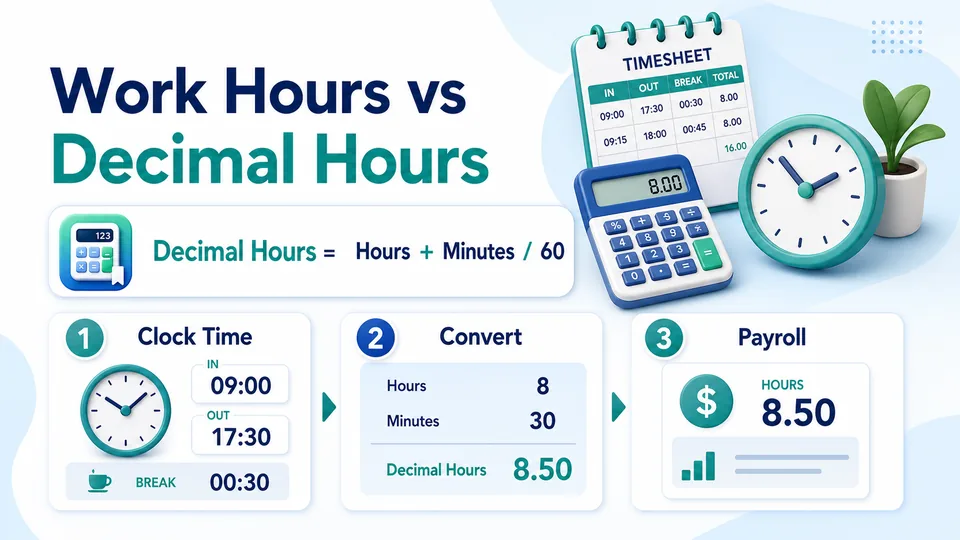
Quick answer
Work Hours vs Decimal Hours is easiest when you identify the input units, apply the formula once by hand, and then verify the result with the calculator.
This guide is written for timesheet users who need to compare clock time with payroll decimal time. The safest way to use any result is to identify the original values, keep the units consistent, and compare the final answer with a small example before you rely on it.
Work Hours vs Decimal Hours example
Scenario: 7 hours 45 minutes on a timesheet
Calculation: 7 + 45 / 60 = 7.75 decimal hours
Result: The result is 7.50 in the reference pattern, and the method can be repeated with your own values.
The important part is not only the number; it is keeping the base value, units, and rounding rule consistent from the first step to the final answer.
Work Hours vs Decimal Hours reference table
| Input | Result | Note |
|---|---|---|
| 7:15 | 7.25 | Useful for payroll entry |
| 7:30 | 7.50 | Half hour |
| 7:45 | 7.75 | Common shift total |
Use the table as a quick sense-check. If your answer is far away from a nearby row, review the inputs before assuming the calculator or formula is wrong.
Common mistakes to avoid
- Entering 7:45 as 7.45 in payroll software
- Rounding each day before adding the week
- Mixing paid hours with scheduled hours
Pre-submit checklist
- Convert minutes by dividing by 60
- Keep a copy of the original clock times
- Apply the employer rounding rule only once
Quick answer for work hours vs decimal hours
Work Hours vs Decimal Hours is easiest when you identify the input units, apply the formula once by hand, and then verify the result with the calculator. In practice, work hours vs decimal hours works best when you keep the units consistent, write down the start and end values, and compare the answer with a simple example.
What you need before calculating
Before you calculate, collect the exact inputs: dates, times, measurements, percentages, or values required by the formula. Work hours vs decimal hours is closely related to work hours calculator, hours calculator, working out hours worked. Keeping these terms in mind helps you choose the right calculator and avoid mixing units.
Step-by-step method
Use the method below as a checklist. Start with the known values, apply the formula once, then check whether the result matches the situation you are trying to solve.
- When to use this method
- Inputs you need before calculating
- The formula in plain English
- Worked example
- Common mistakes to avoid
- How to verify the result with the calculator
Example and common checks
For a reliable work hours vs decimal hours result, test one small example by hand before using larger numbers. Watch for reversed inputs, rounded values, time format mistakes, and unit conversions that change the final answer.
Common questions
When should I use Work Hours vs Decimal Hours?
Use Work Hours vs Decimal Hours when you need to understand the formula or check a calculator result before making a final decision.
What is the most common mistake with Work Hours vs Decimal Hours?
The most common mistake is mixing units, rounding too early, or using a value that does not match the formula.
Can I use the calculator instead of doing the formula by hand?
Yes. The calculator is designed for speed, while the guide explains the method so you can verify the result.
Why do payroll systems use decimal hours?
Decimal hours make multiplication by hourly pay rates simple and reduce confusion when adding weekly totals.
What is 8 hours 15 minutes as a decimal?
8 hours 15 minutes equals 8.25 decimal hours because 15 / 60 = 0.25.
What should I check before using a work hours vs decimal hours result?
Check that the inputs match the formula, units are consistent, and the rounded result still fits the decision you are making.
Can I use the related calculator for work hours vs decimal hours?
Yes. Use the guide to understand the method, then use the related calculator to repeat the calculation quickly with your own numbers.